CURRENT SUPERVISION
Madeleine Cocolas is an Australian composer, producer and researcher, currently based in Tokyo, Japan. She is a PhD candidate at the Queensland Conservatorium Griffith University where she is researching the nexus between music, place and memories through the use of field recordings in the creation of new music. Madeleine is a prolific composer and has published solo music through various international labels including Room40, Someone Good (Australia), Bigo & Twigetti (UK), Superpang (Italy), Self Center Records (US), 1631 Recordings (UK), and Futuresequence (UK), and has written extensively for film and other media. Her albums have garnered positive reviews in publications including Pitchfork, The Wire, Electronic Sound Magazine, Bandcamp’s Album of the Day & Bandcamp’s Best Experimental Music and being listed as an album of the month by NPR. https://www.madeleinecocolas.com/
Tara Pattenden (PhD)
Tara Pattenden is an artist and creative technologist working with tactile electronic instruments, programming, time based media and performance. She is the founder of Cyber Palace, a studio for creative technology workshops and Cyber Bunker, a project space for experimental practice in Meanjin. Tara is a PhD candidate at the Queensland Conservatorium Griffith University, her project combines wearables with participatory practices to discover how costume-based, audience-worn instruments – with visually impactful and intuitive electronic interfaces – can enhance engagement and expression for coauthored audience engagement during participatory sound works. https://tarapattenden.com
Benjamin Colbourne (PhD)
- https://www.collarts.edu.au/about-us/faculty/music-audio/benjamin-colbourne/
- https://www.youtube.com/@b.c.slumber3694
Miles Cosmo Philip (PhD)
This project proposes the use of generative artificial intelligence (AI) as an active agent in a process led creative practice. AI generated compositions and motifs will serve as the basis for bespoke works that hinge on collaboration between human artist and AI model. Through a three stage process of AI generated content collection, user-led manipulation of materials, and controlled curation of the resulting work, I hope to demonstrate the potential of AI as an active tool in the creation of original artworks. The use of generative AI in this practice is borne out of its relevance in the zeitgeist of art discussion, the inherent ethical ramifications of its use, and how it can be harnessed as a collaborative extension of human creative output. https://milescosmo.substack.com/
Mohammad Shakir (PhD)
Mo is embarking on a practice-based research project at Queensland Conservatorium Griffith University, focused on developing open-source tools that simplify the creation of live visuals, using GLSL shaders, Raspberry Pi, and web technologies to design and evaluate applications for generative visual content creation.His research centres on a fundamental challenge in the creative technology space: the tools for creating compelling live visuals are either prohibitively expensive (analog video synthesis equipment) or require steep learning curves (complex software like TouchDesigner, After Effects, or custom programming). Meanwhile, there’s a vibrant community of electronic musicians and visual artists who could benefit from more accessible alternatives. To summarise, my project seeks to answer the questions: How can we lower the barriers to entry for creating generative visuals in live audio-visual performance? What effective methods exist for translating audio signals and control inputs into compelling visual patterns? How might accessible open-source tools foster greater community participation in audio-visual arts? https://moshak67.substack.com/
Tim Tate: Reimagining redundant technologies as a catalyst for new compositional techniques (PhD)
Redundant audio technologies including magnetic-tape, turntables and early samplers are classed as low fidelity audio technologies. Today a minority of practitioners favour these technologies, using hacking/circuit bending techniques to build new instruments, yet their main use lie in performance and installation environments. This project serves to reimagine these redundant technologies as instruments for live performance and tools for sonic transformation, acting as catalysts for new compositional techniques. The reimagining of these technologies as instruments, and the resulting compositional techniques, will be documented alongside their use in a portfolio of creative practices and a written thesis and an interactive website. http://www.timothytate.com.au/about/
Nava Ryan: Acoustic and Electronic Music Performance: Interfaces for Ensemble Interaction (PhD)
The term ‘augmented instrument’ refers to a traditional instrument that has been fitted with sensors. Examples of such sensors include ultrasonic sensors, which measure the distance to an object using ultrasonic sound waves, and three-axis accelerometers which measure accelerations that take place in relation to the three Cartesian coordinate axes (x, y & z). By affixing such sensors to acoustic instruments, it becomes possible to capture performer gesture information and use this data creatively to control electronic multimedia including video, sound and lighting. This research is primarily focused on contributing knowledge through creative, augmented performance practices in an ensemble format.
COMPLETED SUPERVISION
Dr David Chechelashvili: Developing Compositional Strategies for a Modular Synthesizer (PhD)
This PhD project investigates musical composition using a Eurorack modular synthesizer system. The intention is to explore the compositional affordances and limitations of this instrument through composing a series of musical works. A modular synthesizer is a dynamic musical instrument — it lends itself to being updated and modified to suit a composer’s current needs. I am interested in exploring the relationship between the composer and the instrument given the instrument’s mutability. The compositions developed during this project will be primarily electronic, resulting from a novel compositional approach involving multi-parameter control of modular synthesizers through computer software generating serialized data. Modular systems have become very accessible and are more popular than ever before, however, compositional theory in this area is limited. The recent rise in interest in modular synthesis provides fertile ground to carry out this work. Findings of the project will offer further insights the nature of the relationship between the composer and a musical instrument and also into compositional strategies that complement this particular instrument.
- https://research-repository.griffith.edu.au/bitstreams/744ecc4f-aedc-45c0-a0b6-6f4251ff35f7/download
Dr Kevin Purcell (DMA)
In 2024 Kevin Purcell completed DMA project “Remediating Musical Theatre From The Stage To Its Digital Semblance: An Autoethnographic Case Study Of Castle Gillian: An Irish Tale As An Immersive Storyworld”. Castle Gillian was an official selection of the Festival of International Virtual and Augmented Reality Stories, and was recently screened at the Cannes World Film Festival, where it was nominated for Best Soundtrack, and won Best 360º Film, and Best Musical Film. A string of other awards has followed:
- https://castlegillian.com/
- https://research-repository.griffith.edu.au/items/af336795-ec30-4a87-9d6a-0a66051cf26c
Dr Richard Frenneaux (PhD): Networked digital culture: Co-creation and its effects on the creator and creative process within the music industry
This research aims to provide a clearer understanding of the impact of digital networked participatory culture on the creator and on the creative process within the context of the music industry. Artists today are expected to adapt to a rapidly shifting market, where music platforms and consumption patterns are constantly changing. Not only is it important to understand the impact of digital culture on the music creator today, but also to forecast where value within creative exchange is moving, and the extent of its artistic and commercial value. While there has been a great deal of published work examining the impact of participatory exchange on the consumer and on the music industry (e.g. Negus, 2015; Wikström, 2014; Choi & Burnes, 2013), there is very little published work regarding the impact on the creator. Given the extent and pace of change as well as the volume of platforms emerging that hope to harness the potential for participatory exchange, it is timely to undertake a study of the impact on the creator, framed around my own experience as an artist and producer.
- https://research-repository.griffith.edu.au/handle/10072/414587
- https://research.nottingham.edu.cn/en/persons/richard-frenneaux/
Dr Sean Foran (DMA): Improvisation with technology in a jazz context through composition, performance and recording
This project investigates the process of creating new works for two jazz trio ensembles, with a particular emphasis on improvisation with acoustic instruments and technology. Utilising a practice-based research model the project documents and outlines the conceptual basis for the work, reflects on a series of public performances and examines studio recording sessions. By analysing the musical content, use of technology, and the musician’s reflections on their decision-making, the overall goal is to articulate the musical potential of improvising with technology in a jazz context.
- https://research-repository.griffith.edu.au/items/9ce0d614-62a6-4ee4-b2d2-446470ae300a
- https://www.seanforanmusic.info/
Dr Nicole Carroll (PhD): Orrery Arcana: Musical Materiality through Esoteric Devices, a self-made modular hardware controller and software system for real-time audio-visual performance.
Nicole successfully defended her PhD in Computer Music and Multimedia at Brown University (USA) in October 2019 and began a job at The University of Newcastle, Australia in 2020. Nicole took several graduate classes that I taught at Brown 2014-15 and from June 2017 to August 2018 was based in Brisbane as Adjunct Research Fellow at QCGU. During this time she collaborated on a number of research projects, contributed significantly to the Higher Degree by Research community, was involved in undergraduate teaching/demonstration, and developed the main practical component of her PhD: Orrery Arcana. Although I often acted in a supervisory capacity, my official role 2015-2019 was reader on the PhD project.
“Orrery Arcana is a system for real-time audio-visual performance. The system includes a self-made modular hardware controller and custom software that allows the performer to manipulate sound during performance. The hardware controller is used to navigate systems that encompass chance operations, conceptual mapping, and data mapping, to control audio generation and processing. These process systems are based on NASA lunar data, the esoteric system in W.B. Yeats’ (1865-1939) A Vision (1937), and the numerology and symbolism of the tarot.”
- nicolecarrollmusic.com
- https://www.qut.edu.au/about/our-people/academic-profiles/n5.carroll
- https://www.brown.edu/academics/music/news/2018-10/nicole-carroll-and-orrery-arcana
- https://www.brown.edu/academics/music/events/nicole-carroll-presents-her-dissertation-project-orrery-arcana
Greg Olley (Honours): Exploring the Compositional Possibilities of Sampling Pre-Existing Audio Using a Self-Designed Audio Recognition System
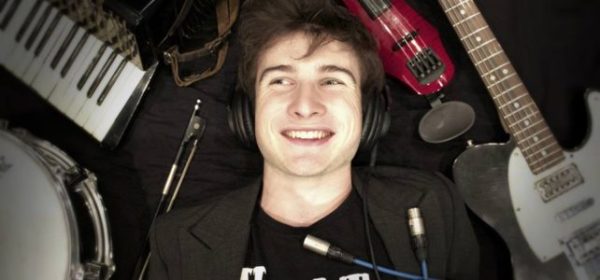
This study explored the compositional possibilities of pitch-based samples. Pitch recognition and sampling technology were used to create a software tool that analysed an audio source and exported samples that matched a pitch specified by the user. These samples were then used as material to compose a portfolio of music that reacted to the challenges posed by this novel approach to sample collection. These compositions and a reflective journal were analysed to study the effects of using this method on my compositional process. This information was used to detail my developing creative processes as well as describe some considerations for other composers interested in this method of sampling.
This project examines the integration of the MIDI keyboard alongside the Traditional Drumset (TD) and suggests that the continual renewal of technology has both shaped the TD and led to the integration of digital technologies. Using a practice-led research model along with action research, this project offers TD practitioners new tools for developing a solo percussion practice using what I call the Augmented Drumset (AD). The primary aim is to develop an idiolect for the AD; achieved through playing, practising, and composing for the AD, devising six parameters, resulting in an iterative process termed the Augmented Drumset Iterative Cycle (ADIC). The ADIC represents one of the three primary outcomes of this research in addition to two original compositions. An important undercurrent throughout this work is the desire for all sound to be a consequence of embodied movement, allowing the compositions to be performed in real-time and not from leveraging any programmed sequences or backing tracks. In addition to this text, a range of scores, videos, and audio recordings are utilised to document and represent this project.
Daniel Phillip Field (Masters): A Real-Time Harmonically Responsive Algorithmic Melody Writing Assistant, Realised Using Procedural Programming with Interactive Control Parameters
https://research-repository.griffith.edu.au/handle/10072/407564